If you follow global economics even casually, you have probably seen some version of this claim: BRICS has overtaken the G7.
It sounds dramatic. It is also only partly true.
The problem is that people often compare the two groups using completely different yardsticks. On one measure, BRICS really does look larger. On another, the G7 is still comfortably ahead. That is why this debate produces so much confusion: people are often answering different questions without realizing it.
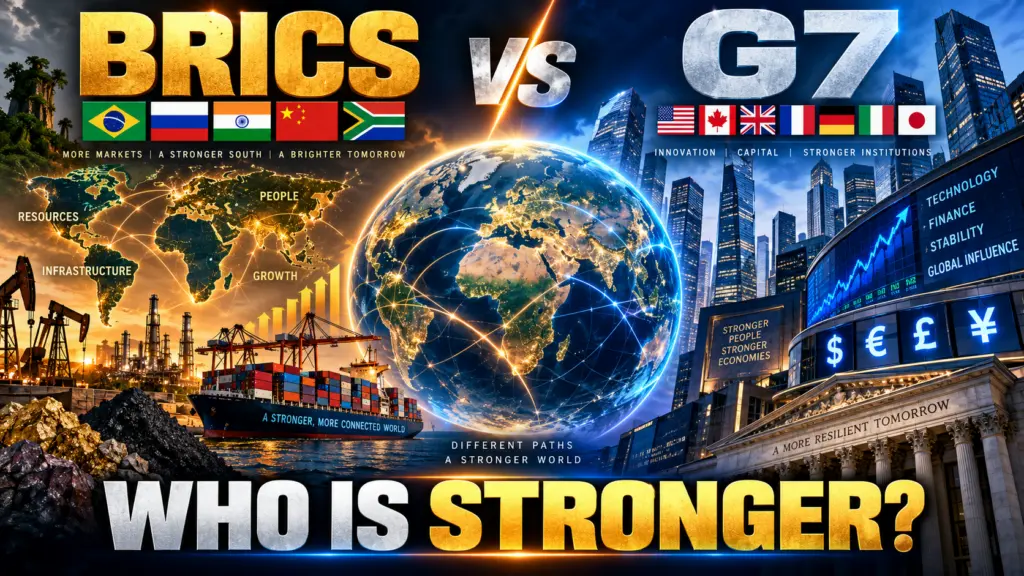
And since BRICS has expanded beyond its original five members, the comparison matters more than it did a few years ago. India’s official 2026 BRICS background note says the bloc now includes 11 countries—Brazil, China, Egypt, Ethiopia, India, Indonesia, Iran, Russia, Saudi Arabia, South Africa and the UAE—and together they account for 49.5% of the world’s population, 40% of global GDP and 26% of global trade. By contrast, the G7 consists of Canada, France, Germany, Italy, Japan, the UK and the US, with the European Union fully involved in its work.
So yes, BRICS is now a much larger bloc than many people still imagine. But size alone does not settle the argument.
The first thing to understand: PPP and nominal GDP are not the same thing
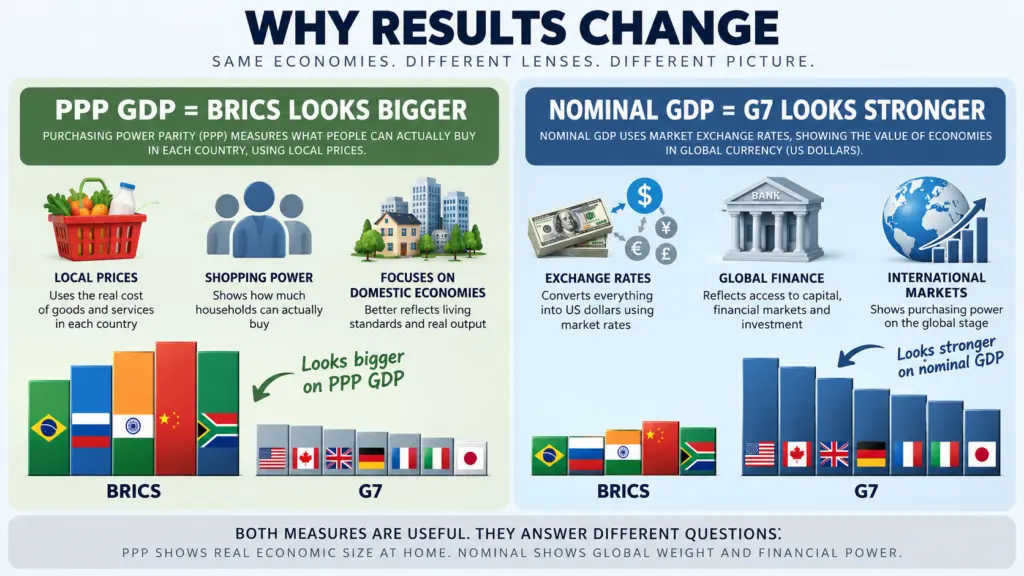
A lot of the “BRICS has overtaken the G7” messaging comes from PPP-based GDP, or purchasing power parity.
PPP adjusts for differences in local prices. In plain English, it asks: how much can money actually buy inside an economy? A dollar converted at market exchange rates does not go equally far in New York, Mumbai, Cairo and São Paulo. PPP tries to correct for that.
That is useful if you want to compare the real scale of domestic economies. It is one reason BRICS looks so big. Emerging economies—especially China and India—have enormous populations and large domestic markets, so PPP gives them more weight.
But nominal GDP uses market exchange rates. That makes it more relevant for global finance, cross-border investment, foreign debt, stock-market value, international acquisitions and reserve-currency power. On that measure, the G7 remains much stronger.
A useful comparison from the European Council’s Forward Look 2025 shows the gap clearly. It puts the G7 at 44.8% of world GDP in current dollars, while showing the original BRICS countries at 24.5% and BRICS+ at 25.9%. The same chart also shows the G7 representing only 9.7% of global population, against 40.3% for BRICS and 44.6% for BRICS+.
That is the heart of the issue. If you want to know which bloc has more people and more economic weight on a PPP basis, BRICS has a strong case. If you want to know which bloc still dominates in dollar-valued output and international finance, the G7 remains ahead.
A simple comparison table: BRICS vs G7
| Measure | BRICS | G7 | Who looks stronger? |
|---|---|---|---|
| Membership | 11 countries | 7 countries | BRICS |
| Population | Very large; about 49.5% of world population | Much smaller; around 9.7% in one EU comparison | BRICS |
| PPP-based economic scale | Strong | Smaller than BRICS on this measure | BRICS |
| Nominal/current-dollar GDP | Large, but below G7 | Very strong | G7 |
| Trade weight | 26% of global trade in India’s 2026 BRICS note | Major advanced trade and services economies | Mixed |
| Financial markets and reserve currencies | More limited | Dominant | G7 |
| Growth potential | Generally higher | Generally slower | BRICS |
| Income per person | Highly uneven, mostly lower | Much higher on average | G7 |
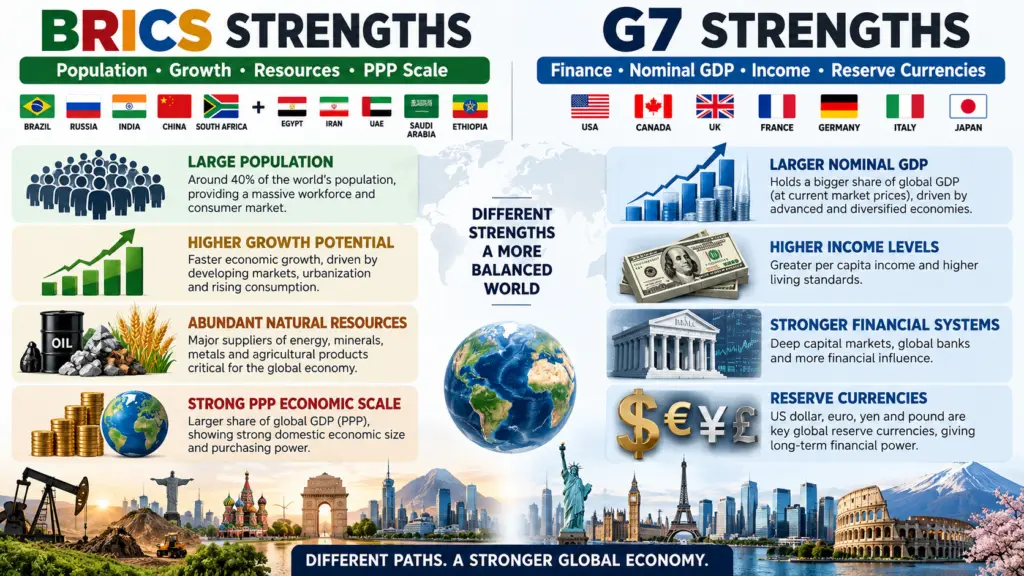
Population and resources are a genuine BRICS strength
This part is not especially controversial. BRICS has scale.
It has China and India, the two biggest population giants. It has major oil exporters such as Saudi Arabia, Russia, Iran and the UAE. It has Brazil’s agricultural and commodity strength. It has Indonesia’s size and strategic role in Southeast Asia. It has Africa represented through South Africa, Egypt and Ethiopia.
That combination matters. It gives BRICS political weight, resource leverage and a huge long-term consumer base. It also helps explain why so many countries want closer engagement with the grouping.
But population is only potential, not automatic power. A bloc can have more people and still generate less wealth per person, weaker financial institutions and lower international monetary influence. That is exactly where the G7 still matters enormously.
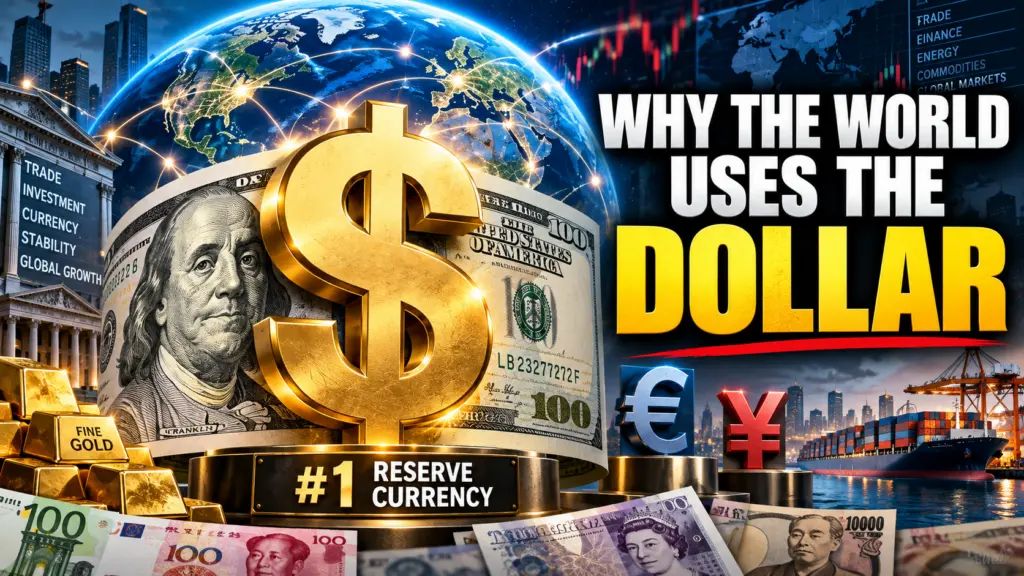
Why the US Dollar Is the World’s Reserve Currency
The US dollar dominates global reserves, currency trading and international finance—but not simply because of US economic……
The G7 remains stronger where global finance still counts most
The G7’s advantage is not just that its economies are rich. It is that they sit at the core of the modern financial system.
The United States alone gives the G7 a massive edge in capital markets, dollar liquidity, corporate depth and financial influence. Add the euro area’s major economies, Japan and the UK, and you have the countries whose currencies, banks, bond markets and institutional frameworks still anchor much of the world economy.
The reserve-currency data makes that hard to ignore. According to the IMF’s July 2026 COFER update for the first quarter of 2026, the US dollar made up 57.13% of allocated global foreign-exchange reserves. The euro stood at 20.03%, while the Chinese renminbi was just 1.99%.
That does not mean the existing system will never change. It means the change is slower—and harder—than some headlines imply.
What about de-dollarization and a BRICS currency?
This is probably the most overhyped part of the story.
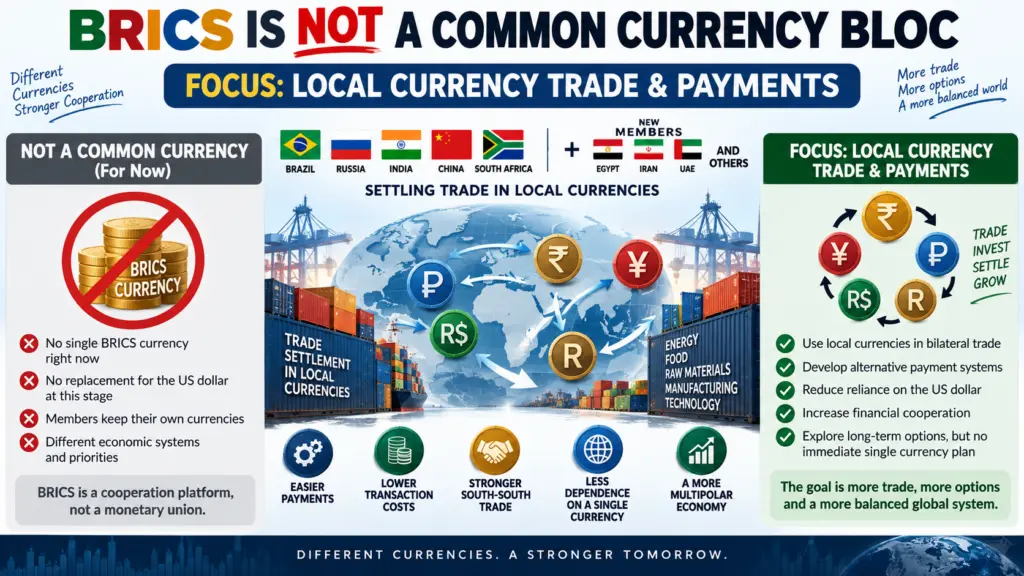
BRICS is clearly trying to deepen financial cooperation. The 2026 New Delhi Declaration acknowledges work by the BRICS Payment Task Force on cross-border payment mechanisms and discussions on promoting trade settlement and investment in local currencies. The same declaration also backs a larger role for the New Development Bank and encourages expansion of local-currency financing.
But that is not the same thing as launching a shared BRICS currency.
At the moment, the more realistic story is this: BRICS is trying to reduce friction in trade settlement, build payment alternatives, and increase the use of member currencies where practical. That could gradually chip away at dollar dependence in some areas. It is a meaningful trend. But it is not a monetary revolution—at least not yet.
So which group is economically stronger?
The honest answer is that they are stronger in different ways.
BRICS is stronger if you are looking at:
- population
- PPP-based economic weight
- growth potential
- commodity and energy leverage
- influence across the Global South
The G7 is stronger if you are looking at:
- nominal GDP
- per-capita income
- reserve currencies
- global finance
- mature institutions, capital markets and corporate power
So when someone says BRICS has overtaken the G7, the right response is not yes or no. It is: on which measure?
That is not a dodge. It is the real answer.
Is the UK Breaking Up? What Scotland, Wales and Northern Ireland Actually Want
Talk of a breakup of the United Kingdom has moved back into mainstream politics after nationalist leaders from Scotland,…..
Key Takeaways
- BRICS now has 11 full members and nearly half the world’s population.
- The G7 still carries far more weight in nominal GDP and global finance.
- PPP-based comparisons often make BRICS look larger because they adjust for differences in domestic prices.
- The G7 remains central to reserve currencies, especially through the US dollar and the euro.
- BRICS is becoming too important to dismiss, but it has not replaced the G7 across every meaningful economic measure.
- The most accurate view is that global economic power is broadening—not simply flipping from one bloc to the other.
Frequently Asked Questions
Has BRICS overtaken the G7 economically?
Only on some measures. BRICS looks larger on PPP-based comparisons and is much larger by population, but the G7 remains stronger in nominal GDP and financial influence.
Why do some charts show BRICS ahead and others show the G7 ahead?
Because they are using different indicators. PPP GDP and nominal GDP are not interchangeable, and they answer different economic questions.
Which countries are in BRICS in 2026?
Brazil, China, Egypt, Ethiopia, India, Indonesia, Iran, Russia, Saudi Arabia, South Africa and the UAE.
Which countries are in the G7?
Canada, France, Germany, Italy, Japan, the United Kingdom and the United States. The European Union is also fully involved in G7 work.
Does BRICS have a common currency?
No. BRICS is discussing payment cooperation and wider use of local currencies, but it has not created a common currency.
Why is the G7 still so influential?
Because economic power is not just about population or PPP. The G7 still dominates in global finance, reserve currencies, high-income markets and major capital-market institutions.
Final Thoughts
The BRICS-vs-G7 debate is often framed as a contest with a single winner. That makes for clean headlines, but it is not how the global economy actually works.
BRICS represents the rise of large emerging economies and a broader redistribution of global economic weight. The G7 represents the staying power of wealth, financial depth and institutional power built over decades.
If you want the clearest takeaway, it is this: BRICS has become too big to ignore, but the G7 is still too powerful to write off. The world economy is no longer centered as narrowly as it once was—yet it has not been fully reordered either.