For years, predictions that the United Kingdom might eventually break apart sat somewhere between constitutional debate and political speculation. In September 2026, however, that question became harder to dismiss.
The leaders of the SNP, Plaid Cymru and Sinn Féin met in Cardiff and signed a joint statement arguing that Scotland, Wales and Northern Ireland should be able to determine their constitutional futures democratically. They also called on the British government to prepare for possible constitutional change.
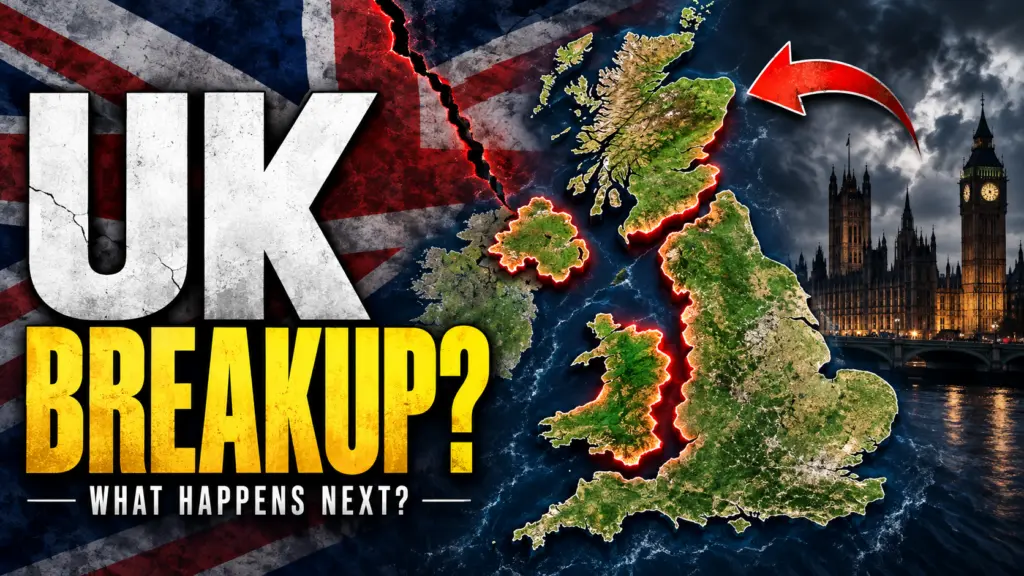
That sounds dramatic. But it does not mean the UK has begun a formal breakup process.
The more useful question is not simply whether Britain is “breaking up”, but how close each of its constituent nations actually is to having the legal and political conditions required to leave.
First, What Exactly Is the United Kingdom?
A surprising amount of confusion begins here.
| Term | What it means |
|---|---|
| England | One of the four nations of the UK |
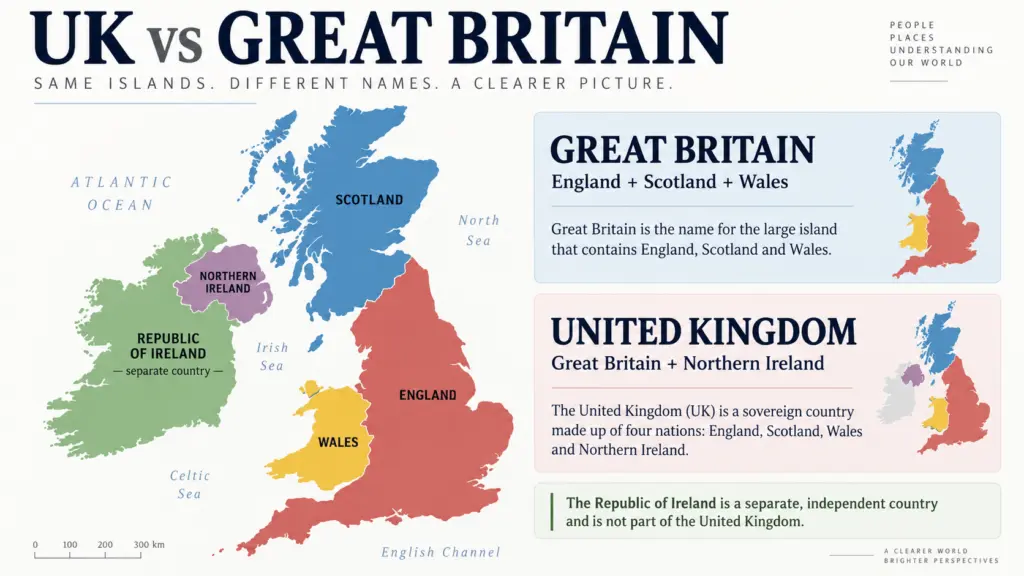
| Great Britain | England, Scotland and Wales |
| United Kingdom | England, Scotland, Wales and Northern Ireland |
| Republic of Ireland | A separate sovereign state and EU member |
The UK’s formal name is the United Kingdom of Great Britain and Northern Ireland.
It did not appear all at once. Wales was incorporated into the English state through legislation in the 16th century. England and Scotland became one state called Great Britain under the Acts of Union in 1707. Great Britain and Ireland were then united in 1801. Most of Ireland left the UK in the early 1920s, while Northern Ireland remained.
That history matters because today’s United Kingdom is not a federation built from one modern founding constitution. It evolved through a series of unions, statutes and political settlements. The House of Commons Library describes it as a state comprising four nations.
What Happened at the Cardiff Summit?
On 14 September 2026, SNP leader and Scottish First Minister John Swinney, Plaid Cymru leader and Welsh First Minister Rhun ap Iorwerth, and Sinn Féin’s Michelle O’Neill met in Cardiff alongside Sinn Féin president Mary Lou McDonald.
Their joint declaration argued that constitutional change was coming and that Westminster should not prevent nations from exercising self-determination.
There is an important qualification, however.
The participants were acting in their party-political capacities, rather than signing a binding intergovernmental agreement on behalf of all three devolved administrations. That distinction is particularly important in Northern Ireland, where O’Neill shares executive leadership with DUP deputy First Minister Emma Little-Pengelly, whose party supports remaining in the UK.
So this was politically significant, but it was not a legal decision to dissolve the United Kingdom.
Why the US Dollar Is the World’s Reserve Currency
The US dollar dominates global reserves, currency trading and international finance—but not simply because of US economic……
Scotland Is Still the Most Advanced Independence Case
Scotland has already held an independence referendum.
On 18 September 2014, 55.25% voted No and 44.65% voted Yes, on turnout of 84.6%.
The constitutional environment later changed considerably because of Brexit. In the 2016 EU referendum, Scotland voted by roughly 62% to 38% to remain in the European Union, while the UK as a whole voted to leave.
That became one of the central arguments used by the SNP for another independence vote.
Scotland’s pro-independence movement received another political boost in 2026. The Scottish Government has published a draft referendum bill and says the May election produced a pro-independence majority in Holyrood.
But there is a major legal obstacle.
In 2022, the UK Supreme Court ruled that the Scottish Parliament could not unilaterally legislate for an independence referendum because the Union is a matter reserved to Westminster.
In practical terms, Scotland needs political agreement with the UK government — or a change in the legal settlement — for a referendum with an uncontested constitutional basis.
Has the UK Government Changed Its Position on Scotland?
Not clearly.
In July 2026, Prime Minister Andy Burnham told John Swinney that another independence referendum was “off limits”.
But the debate reopened in September when Burnham told Parliament that Scotland could be compared with Northern Ireland in circumstances where public opinion had shifted clearly enough to require the constitutional question to be considered.
Swinney interpreted those remarks as acceptance of the principle that Scotland should eventually be allowed another vote and asked for talks on a legal mechanism.
That should not be confused with Westminster actually approving another referendum. The dispute is still very much alive.
BRICS vs G7: How the Two Blocs Really Compare Economically
BRICS and the G7 are often presented as rivals for control of the global economy, but the comparison is more complicated …..
Wales Is Changing — but Independence Is Further Away
Wales has traditionally had a weaker independence movement than Scotland, but the political picture changed sharply when Plaid Cymru’s Rhun ap Iorwerth became First Minister in May 2026.
Plaid wants the power to determine the timing and process of a future independence referendum transferred to Wales.
Legally, however, Wales faces a problem similar to Scotland. The union between England and Wales is reserved to Westminster, and there is no automatic statutory route through which the Welsh government can call a binding independence referendum.
Another misconception concerns Brexit.
Unlike Scotland and Northern Ireland, Wales voted to leave the EU in 2016, by 854,572 votes to 772,347.
That makes the Welsh constitutional debate different from Scotland’s and means Brexit alone cannot explain the rise of Welsh nationalism.
Northern Ireland Has a Completely Different Route
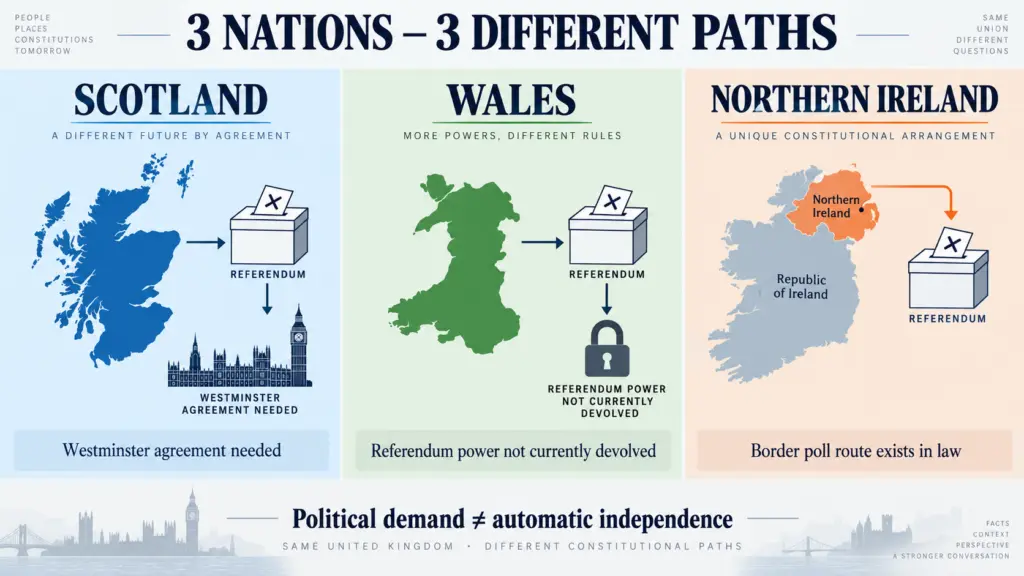
Northern Ireland is the most legally distinctive case.
Under the Northern Ireland Act 1998 and the Good Friday Agreement settlement, Northern Ireland remains in the UK unless a majority votes to join a united Ireland.
The Secretary of State for Northern Ireland must call a referendum — commonly called a border poll — if it appears likely that a majority would vote for reunification. If a reunification referendum fails, another cannot be held for at least seven years.
Scotland and Wales have no equivalent automatic statutory mechanism.
That means the three nationalist movements may cooperate politically, but their routes to constitutional change are fundamentally different.
Where Does Donald Trump Fit Into This?
US President Donald Trump added international attention to the issue during a September 2026 visit to Ireland, when he publicly expressed support for Irish reunification.
His remarks caused irritation among some unionists and attracted considerable attention because of America’s historic role in the Northern Ireland peace process.
But a US president cannot trigger a Northern Ireland border poll or decide the UK’s constitutional future.
That authority remains governed by British and Irish constitutional arrangements and, ultimately, by voters.
It would therefore be misleading to claim that Trump’s comments mean the United States is “breaking up Britain”.
So, Is the United Kingdom Actually About to Break Up?
No — not imminently.
But the constitutional pressure is more serious than it has been at many points in the recent past.
For the first time, pro-independence leaders simultaneously occupy the First Minister positions in Scotland, Wales and Northern Ireland. Their parties are now openly coordinating on self-determination and asking Westminster to prepare for constitutional change.
That creates political momentum. It does not create independence by itself.
Scotland still faces a Westminster veto over a lawful referendum. Wales does not currently have its own legal referendum mechanism. Northern Ireland has a legal pathway, but the statutory threshold for calling a border poll still has to be met.
The more accurate description, then, is that the future structure of the United Kingdom has become a live political question again.
Key Takeaways
- The United Kingdom consists of England, Scotland, Wales and Northern Ireland.
- Nationalist leaders from Scotland, Wales and Northern Ireland signed a joint political declaration in Cardiff in September 2026.
- The agreement does not itself begin the legal dissolution of the UK.
- Scotland cannot currently hold a unilateral independence referendum under the existing devolution settlement.
- Wales also lacks an automatic legal route to an independence referendum.
- Northern Ireland is different because the Good Friday Agreement framework provides a statutory route to a referendum on Irish reunification.
- The UK is not about to disappear overnight, but constitutional change is now a significant part of mainstream British politics.
Frequently Asked Questions
Is the United Kingdom really breaking up?
Not currently. There is growing political pressure for constitutional change, but no formal legal process has begun that would automatically separate Scotland, Wales or Northern Ireland from the UK.
Can Scotland legally leave the UK?
Yes in principle, but the present Scottish Parliament cannot unilaterally legislate for an independence referendum. The Supreme Court confirmed in 2022 that the Union is a reserved matter, meaning a lawful route would require Westminster involvement or a change to the legal framework.
Did Scotland already vote against independence?
Yes. In the September 2014 referendum, 55.25% voted to remain in the UK and 44.65% voted for independence.
Can Wales hold an independence referendum?
Not on its own under the existing settlement. Matters concerning the union of England and Wales are reserved to Westminster. Plaid Cymru wants the necessary referendum powers transferred to Wales.
Can Northern Ireland join the Republic of Ireland?
Yes, if a majority votes for Irish reunification in a border poll held under the Northern Ireland Act 1998 and the wider Good Friday Agreement framework.
Is Northern Ireland the same as Ireland?
No. Northern Ireland is part of the United Kingdom. The Republic of Ireland is a separate sovereign country and a member of the European Union.
Did Brexit cause the current independence movements?
Not by itself. Scottish, Welsh and Irish nationalist movements predate Brexit. However, Brexit significantly changed the Scottish debate because Scotland voted strongly to remain in the EU. Northern Ireland also voted Remain, while Wales voted Leave.
Does Donald Trump have any power over Irish reunification?
No. His comments may carry diplomatic and political weight, but the constitutional process is governed by the Good Friday Agreement framework, UK law and democratic consent in Ireland.
Final Thoughts
The Cardiff summit matters because it brings three separate constitutional movements into the same political conversation. But treating it as proof that Britain is already “splitting into four countries” would go too far.
The real story is subtler — and arguably more important. Scotland, Wales and Northern Ireland are questioning Westminster’s authority in different ways, under different laws and with very different levels of public support.
The United Kingdom is still intact. The argument over what it should look like in the future, however, is becoming much harder for Westminster to avoid.