Central banks from Tokyo to Brasília hold dollars. Companies that never sell a product in the United States borrow in dollars. Commodities, international loans and cross-border transactions are frequently priced or settled in the American currency.
So why does one country’s money play such an outsized global role?

The simple answer is that the dollar combines something no rival currency currently provides at the same scale: a huge supply of liquid financial assets, exceptionally deep markets, widespread acceptance and an established global financial network. History gave the dollar a major advantage, but network effects have helped preserve it long after the post-war monetary system that originally formalized its position disappeared.
And one distinction matters from the start: the dollar is not the world’s only reserve currency. It is the world’s leading reserve currency.
What Does “Reserve Currency” Actually Mean?
A reserve currency is a currency that central banks and other monetary authorities hold as part of their foreign exchange reserves.
Countries may use those reserves to stabilize their currencies, pay external obligations, provide foreign-currency liquidity during financial stress or maintain confidence that they can pay for essential imports.
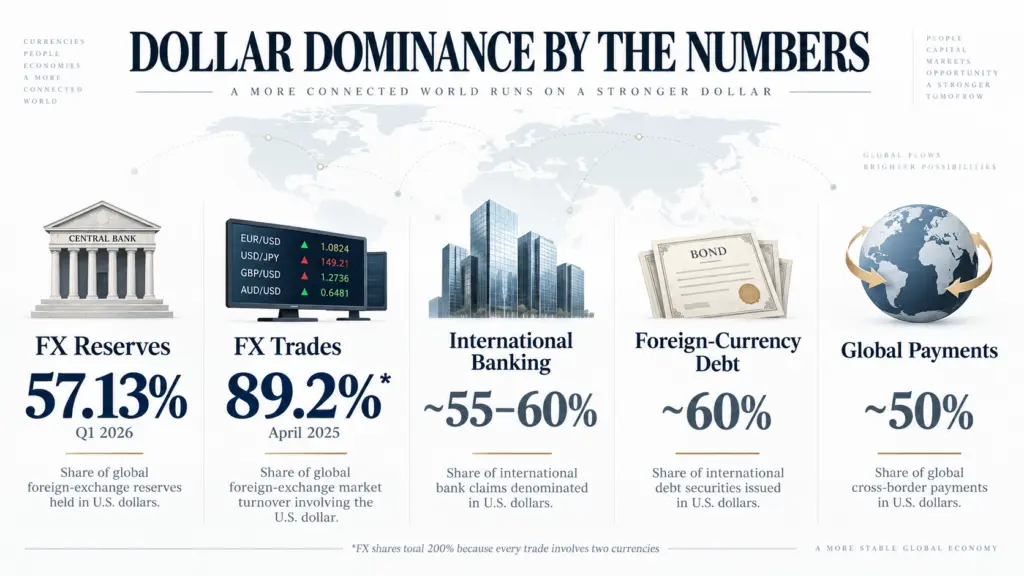
The latest IMF COFER data show that the US dollar accounted for 57.13% of global foreign exchange reserves in the first quarter of 2026. The euro was a distant second at 20.03%, while the Chinese renminbi accounted for 1.99%.
That alone, however, understates the dollar’s international importance.
| Measure | Dollar’s International Role |
|---|---|
| Global FX reserves | 57.13% in Q1 2026 |
| Foreign-exchange trading | On one side of 89.2% of trades in April 2025 |
| International banking | Roughly 55% of international/foreign-currency claims and around 60% of liabilities in recent Federal Reserve data |
| Foreign-currency debt issuance | Around 60% denominated in dollars in recent Federal Reserve data |
| International payments | Roughly half of international SWIFT payments in the Federal Reserve’s recent assessment |
The BIS reported that the dollar appeared on one side of 89.2% of all foreign-exchange trades in April 2025. FX shares add to 200%, rather than 100%, because every currency transaction involves two currencies.

BRICS vs G7: How the Two Blocs Really Compare Economically
BRICS and the G7 are often presented as rivals for control of the global economy, but the comparison is more complicated …..
How the Dollar Became the Leading Reserve Currency
The dollar’s rise did not begin with a single agreement.
The United States became a much larger economic and financial power during the first half of the 20th century, while Britain’s relative financial dominance weakened through two world wars.
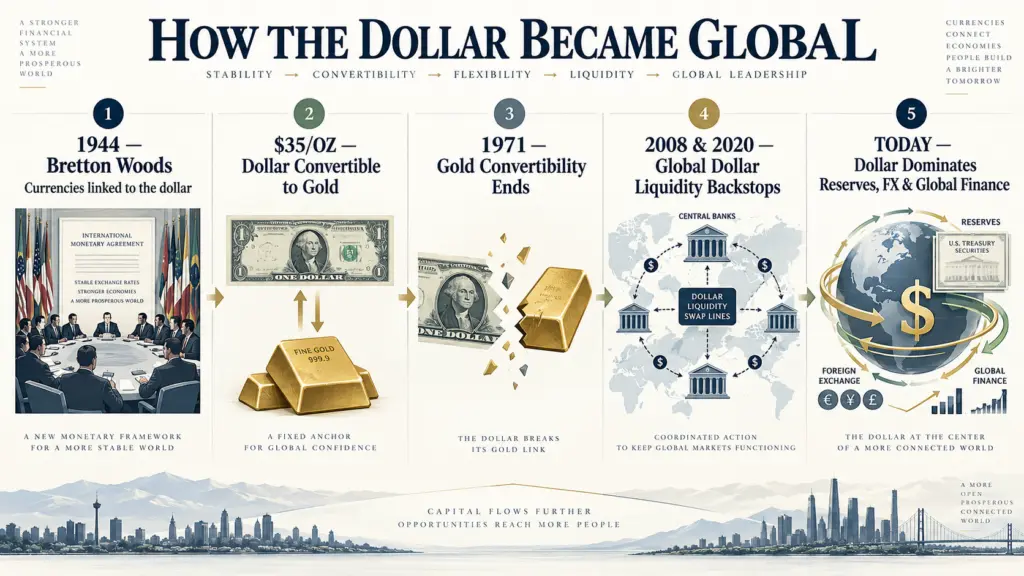
The decisive institutional moment came at the Bretton Woods conference in 1944. Under the post-war system, participating currencies were linked to the dollar, while the United States committed to convert dollars held by foreign monetary authorities into gold at $35 per ounce.
By the time the Bretton Woods system became fully operational, the dollar was at the center of international settlements.
That system eventually became unsustainable. In August 1971, President Richard Nixon ended the dollar’s convertibility into gold, beginning the end of the Bretton Woods arrangement.
But something important happened afterward:
The dollar remained dominant even without gold backing.
That tells us that modern reserve-currency status depends much more on financial markets, economic institutions and widespread usage than on convertibility into a commodity.
Why the US Dollar Remains Dominant
1. The United States Has an Enormous Financial Market
A reserve manager holding hundreds of billions of dollars cannot simply put that money into ordinary bank accounts.
It needs securities that can absorb enormous transactions, trade continuously and be sold quickly without destabilizing prices.
US Treasury securities provide that infrastructure.
Marketable US government debt outstanding reached almost $29.7 trillion in fiscal year 2025, according to US Treasury budget documents.
That scale matters.
Central banks, sovereign wealth funds, banks, pension funds and private investors can move very large amounts of capital through Treasury markets. Few other markets combine comparable size, liquidity and the availability of securities across a wide range of maturities.
2. Dollars Are Easy to Buy, Sell and Hedge
Liquidity creates another advantage.
Because so many financial institutions already transact in dollars, converting dollars into euros, yen, pounds or emerging-market currencies is generally straightforward.
The BIS’s 2025 survey illustrates the scale of this network: the dollar was involved in 89.2% of FX transactions.
A currency that everyone already trades becomes cheaper and easier for the next participant to use.
That is a classic network effect.
3. International Trade Reinforces Dollar Use
A Brazilian company buying goods from an Asian supplier may use dollars even if neither company is American.
Why?
If suppliers quote prices in dollars, banks provide dollar financing and commodity contracts are dollar-denominated, using the same currency can reduce complexity.
Federal Reserve research has found extremely high historical dollar invoicing shares outside Europe—including 96% in the Americas and 74% in the Asia-Pacific region in the underlying trade-invoicing dataset.
This creates a reinforcing cycle:
trade in dollars → demand for dollar banking → dollar borrowing → dollar reserves → more dollar liquidity.
The BIS describes similar feedback between dollar trade invoicing and dollar-denominated financing.
4. Businesses and Banks Borrow in Dollars
The dollar is not simply something central banks hold.
International banks lend in dollars, companies issue dollar-denominated bonds, investment funds hold dollar assets and multinational businesses maintain dollar working capital.
Federal Reserve data indicate that roughly 55% of international and foreign-currency banking claims and around 60% of corresponding liabilities have recently been dollar-denominated. Dollar-denominated foreign-currency debt issuance has also been around 60%.
Once borrowers owe dollars, they need access to dollars in the future.
That creates additional structural demand.
5. Institutional Confidence Matters
The Federal Reserve identifies several foundations of dollar dominance: the size and strength of the US economy, openness to trade and capital flows, strong property rights, rule of law and unusually deep and liquid financial markets.
That does not mean US institutions or Treasury securities are risk-free.
Fiscal policy, inflation, political uncertainty, sanctions policy and institutional credibility can all affect investor confidence.
But reserve managers do not choose currencies in isolation. They compare alternatives.
A rival must offer not merely stability, but also an enormous supply of investable assets, open capital markets, liquidity, convertibility and a financial system capable of handling global demand.
6. The Federal Reserve Can Supply Dollars During Crises
Dollar dependence becomes especially visible when financial markets are under stress.
The Federal Reserve maintains liquidity swap arrangements with major foreign central banks, allowing those institutions to obtain dollars and provide them to banks in their jurisdictions.
During the 2008–09 financial crisis and the 2020 pandemic shock, Federal Reserve dollar swap lines reached roughly $585 billion and $450 billion outstanding respectively.
This crisis backstop strengthens the wider dollar system because global financial institutions know mechanisms exist to address severe dollar-funding shortages.
Why Network Effects Make Dollar Dominance Difficult to Replace
Imagine a new messaging service competing with one that almost every business you know already uses.
The newcomer may have excellent technology, but switching has limited value unless customers, suppliers and partners switch too.
Currencies work similarly.
Businesses prefer currencies accepted by counterparties. Banks prefer currencies with liquid markets. Investors prefer assets they can easily sell. Central banks prefer reserves they can deploy quickly.
Each use supports another.
That is why reserve-currency transitions can take decades rather than years.
The Federal Reserve notes that the last major transition—from sterling to the dollar—developed over a long period and was connected to major changes in global economic power.
Could the Euro or Chinese Yuan Replace the Dollar?
Possible eventually? Yes.
Imminent? The evidence does not currently support that conclusion.
The euro has a large economy behind it, credible institutions and sophisticated financial markets. But Europe’s safe-asset market is spread across multiple sovereign issuers, and the pool of jointly backed EU debt remains substantially smaller than the US Treasury market.
The Chinese renminbi benefits from China’s enormous role in global trade, but China’s capital controls and incomplete currency convertibility limit its usefulness as a global financial and reserve asset. BIS analysis notes that renminbi international use remains below China’s share of the world economy.
Meanwhile, reserve diversification is real. The dollar’s reserve share is lower than its roughly 70%-plus levels around the turn of the century, and central banks increasingly hold smaller currencies and gold.
But diversification is not the same thing as replacement.
Common Misconceptions About Dollar Dominance
“The dollar is dominant because oil must be sold in dollars.”
Oil pricing helped strengthen dollar usage, but it cannot explain the entire global system.
The dollar dominates FX trading, debt issuance, banking, reserves and trade invoicing across industries far beyond energy.
“The dollar is valuable because it is backed by gold.”
It has not been convertible into gold under the Bretton Woods system since 1971.
Modern dollar demand is based on the US economy, financial assets, institutions, taxation, monetary credibility and the currency’s usefulness within the global financial system.
“If BRICS countries trade in local currencies, the dollar stops being the reserve currency.”
Bilateral local-currency trade can reduce dollar use in particular transactions.
But replacing the dollar as the dominant reserve and financing currency would require much more: large liquid asset markets, broad convertibility, deep FX markets, international borrowing, trusted institutions and worldwide adoption.
Key Takeaways
- The dollar is the leading, not the only, global reserve currency.
- It represented 57.13% of global FX reserves in Q1 2026.
- The dollar was involved in 89.2% of global FX trades in April 2025.
- Deep US Treasury and capital markets give international investors somewhere to place enormous pools of dollar savings.
- Dollar trade, lending, borrowing and reserve holdings reinforce one another through network effects.
- Dollar dominance can weaken over time, but replacing the surrounding financial ecosystem is much harder than simply conducting more trade in another currency.
Frequently Asked Questions
Why do central banks keep US dollars?
Central banks hold dollars because dollar assets are widely accepted, liquid and useful for international payments, currency intervention and financial emergencies. The enormous Treasury market also provides reserve managers with a large pool of tradable dollar-denominated securities.
Is the US dollar still backed by gold?
No. The Bretton Woods arrangement linked the dollar to gold at $35 per ounce for foreign monetary authorities, but the United States ended dollar-gold convertibility in August 1971. Modern dollars are fiat currency.
What percentage of world reserves are US dollars?
According to the IMF’s latest available COFER data, the dollar accounted for 57.13% of global foreign exchange reserves in Q1 2026. The IMF revised its COFER methodology beginning with the 2025Q3 release, so older publications may show slightly different historical shares.
Why isn’t the Chinese yuan already a major reserve currency?
China is a major trading economy, but international reserve currencies need more than trade volume. Capital-market accessibility, convertibility, investor confidence and the ability to move very large amounts of capital freely are also important. The renminbi represented 1.99% of global FX reserves in Q1 2026.
Is the euro a reserve currency?
Yes. The euro is the world’s second-largest reserve currency. It accounted for 20.03% of global foreign exchange reserves in Q1 2026, considerably below the dollar’s 57.13% share.
Could the dollar lose reserve-currency status?
Yes. Reserve-currency dominance is not permanent. Persistent inflation, deterioration in institutional credibility, severe restrictions on capital markets or the emergence of a substantially more attractive alternative could weaken the dollar. Such transitions, however, tend to depend on broad structural changes rather than a single political agreement.
Does de-dollarization mean the dollar is collapsing?
No. De-dollarization can describe countries diversifying reserves, settling some trade in other currencies or developing alternative payment systems. Those developments can gradually reduce dollar usage without implying that the dollar is close to losing its leading international role.
Final Thoughts
The dollar’s reserve-currency status is sometimes described as though the world simply chose the American currency and could just as easily choose another one.
The reality is more complicated.
Today’s dollar system is the product of history, but it survives because reserves, Treasury securities, international lending, foreign-exchange markets, trade invoicing and financial infrastructure reinforce one another.
The important question is therefore not simply, “Could another country persuade more people to use its currency?”
It is whether another monetary system can provide a similarly large, open, liquid and trusted financial ecosystem.
So far, no alternative does that at comparable scale.