Starting a business no longer automatically means renting a shop, putting up a signboard and waiting for customers to walk in. An entrepreneur in India can now sell through a website, social media, an online marketplace or even WhatsApp without operating a conventional retail outlet.
That does not make an online business automatically better.
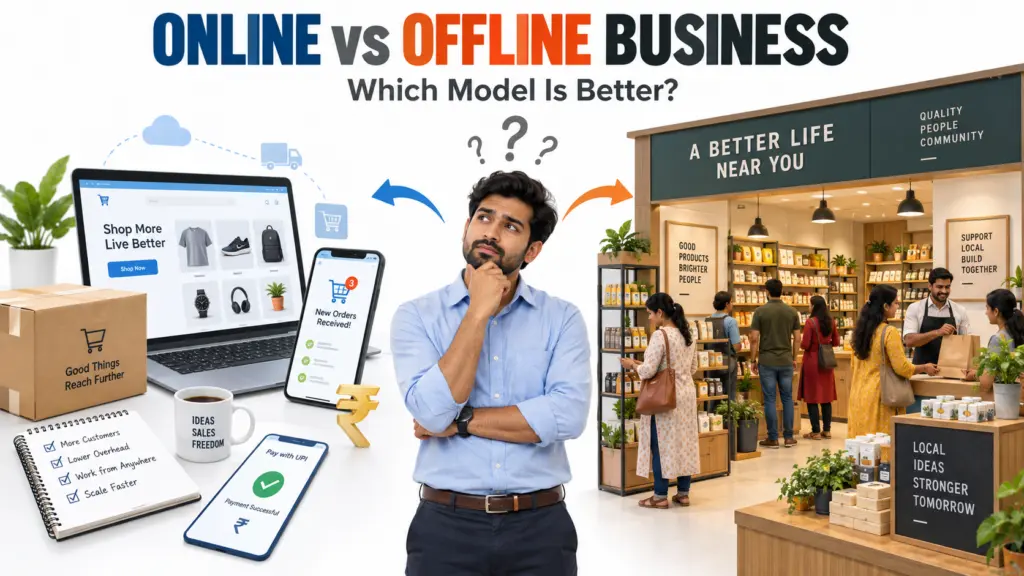
A bakery, coaching service, clothing brand and neighbourhood pharmacy have very different requirements. The better question is therefore not simply online business vs offline business — which wins? It is: Which model gives your particular business the best combination of demand, margins, customer trust and manageable risk?
Here is how to decide.
What Is the Difference Between Online and Offline Business?
An online business primarily attracts, sells to or serves customers through digital channels. Examples include e-commerce stores, SaaS businesses, online courses, digital agencies and marketplace sellers.
An offline business depends mainly on a physical location and face-to-face transactions. Restaurants, salons, repair centres, local grocery stores and many clinics are common examples.
There is also a third option: hybrid business. A clothing retailer, for example, could operate a physical showroom while accepting orders through its own website, Instagram and WhatsApp.
Online Business vs Offline Business: Quick Comparison
| Factor | Online Business | Offline Business |
|---|---|---|
| Initial setup cost | Often lower | Often higher |
| Rent requirement | May be minimal or unnecessary | Usually significant |
| Geographic reach | Potentially national or global | Mostly location-dependent |
| Customer interaction | Digital | Face-to-face |
| Scaling | Usually easier geographically | Often requires additional locations |
| Physical product experience | Limited | Strong |
| Marketing | SEO, social media, ads, marketplaces | Location, referrals, outdoor and local marketing |
| Competition | Potentially very high | Often more locally concentrated |
| Logistics | Shipping and returns can be major issues | Customers often collect immediately |
| Technology dependence | High | Low to moderate |
| Customer data | Easier to measure digitally | Often harder unless systems are used |
These are tendencies, not guarantees. A poorly marketed online store can cost more to acquire customers than a well-located physical shop.
Check This: Business News India
When an Online Business Makes More Sense
The strongest advantage of an online model is usually lower dependence on location.
Imagine someone selling customised stationery from Dehradun. A physical shop primarily depends on nearby customers. An online store could potentially accept orders from Delhi, Mumbai, Bengaluru or anywhere else the seller can economically deliver.
Online businesses can also test demand without committing to an expensive retail property.
This is particularly attractive for:
- digital services and consulting
- software and subscription products
- online education
- niche products with customers spread across India
- lightweight products that are economical to ship
- businesses started alongside a regular job
- products whose demand can be tested through small inventory batches
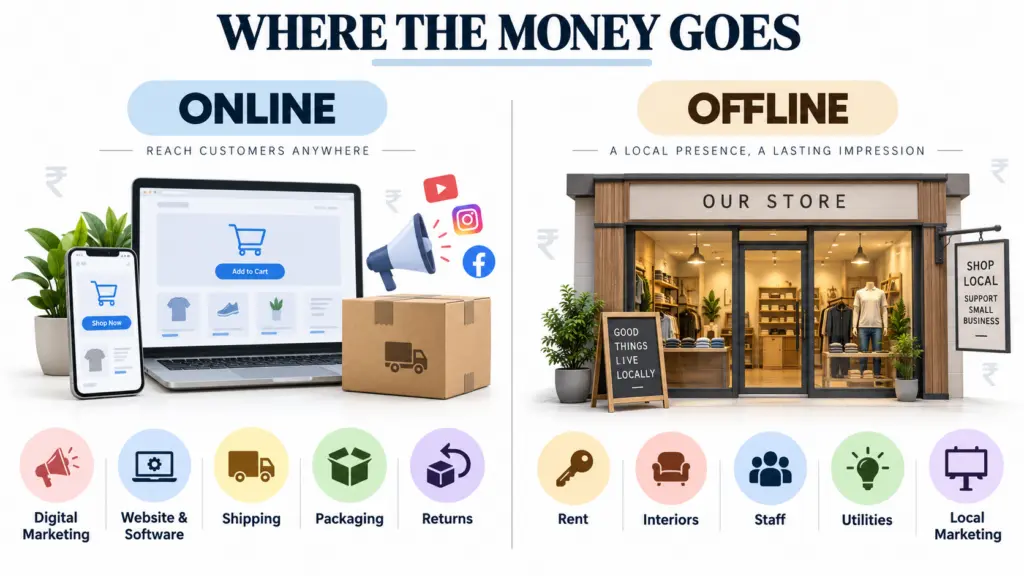
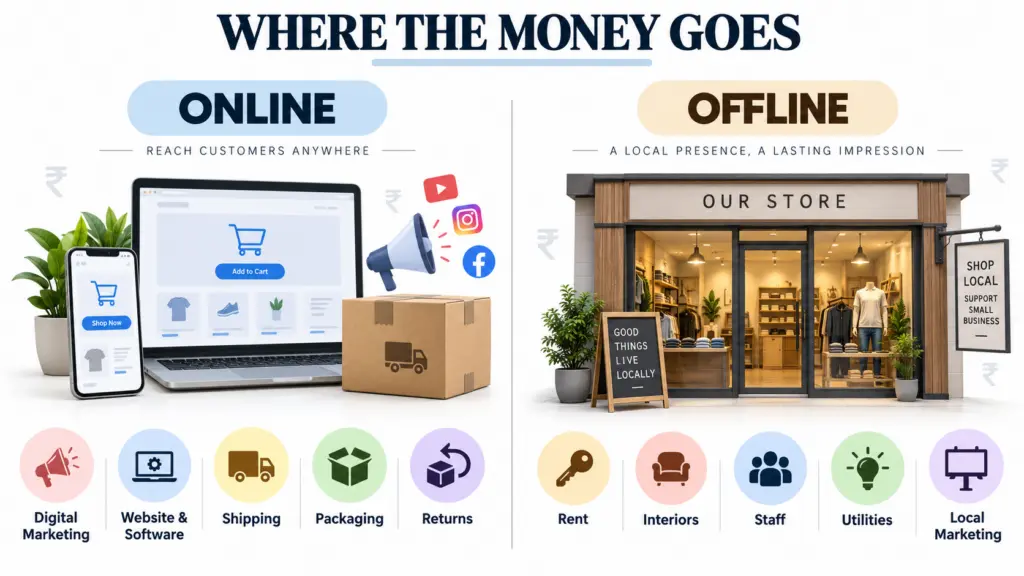
But “no shop rent” does not mean “no costs”. Website development, marketplace commissions, payment charges, digital advertising, packaging, shipping, returns, software and customer support can become substantial expenses.
When an Offline Business Can Be Better
Physical businesses have an advantage whenever location, immediate access or physical experience strongly influences the purchase.
Think about a salon. Customers cannot receive the haircut digitally. A café depends heavily on atmosphere and convenience. Furniture buyers may want to sit on a sofa before purchasing it.
Offline businesses can therefore perform particularly well in areas such as:
- restaurants and cafés
- salons and spas
- healthcare and certain professional services
- repair and maintenance
- gyms and fitness centres
- convenience retail
- businesses where customers need to inspect or try products
- neighbourhood services built on repeated local relationships
A visible physical establishment can also reduce perceived risk for some customers. The trade-off is higher fixed expenditure: rent, interiors, electricity, employees, local licences and potentially larger upfront investment.
The Real Cost Difference Is More Complicated Than Rent
Consider two hypothetical entrepreneurs selling fashion accessories.
Business A starts online from home. It avoids ₹30,000 of monthly shop rent but spends ₹25,000 on online advertising, ₹12,000 on shipping-related costs and ₹8,000 on software, content and other digital operations.
Business B rents a physical shop for ₹30,000 but gets substantial walk-in traffic and spends only ₹5,000 on local promotion.
The online company is not automatically cheaper simply because it has no storefront.
The useful calculation is:
Contribution after product costs – customer acquisition – delivery/transaction costs – fixed operating costs
That tells you much more than comparing rent alone.
Quick Tip: Before choosing a model, estimate the cost of acquiring one paying customer through each channel.
Online Business Can Scale Faster — But Competition Scales Too
An online company can potentially expand from one city to several states without opening another storefront.
That is powerful.
Unfortunately, customers can also compare you with dozens of competing businesses in seconds. Online growth frequently requires strong product positioning, reviews, content, advertising, search visibility or an existing audience.
A physical shop faces geographic limitations, but a strong location can itself become a competitive advantage.
Why Hybrid Businesses Are Increasingly Attractive
For many businesses, the best answer is neither 100% online nor 100% offline.
Consider a local clothing store that allows customers to:
- inspect products in the showroom
- discover new collections on Instagram
- order through a website or WhatsApp
- pay digitally using UPI
- choose home delivery or store pickup
The physical outlet builds confidence and provides product experience, while digital channels increase reach and repeat purchases.
A business does not need to launch every channel simultaneously. An entrepreneur might validate demand online first and open a physical outlet later, or start locally and add e-commerce after understanding customers.
What About GST and Business Registration in India?
Tax obligations should be checked separately from the choice of online or offline business.
GST registration depends on factors including turnover, nature of supply, state and specific statutory exceptions. Selling through an e-commerce platform also has special provisions.
Importantly, the older assumption that every goods seller using an e-commerce operator must obtain GST registration regardless of turnover is no longer universally correct. Notification 34/2023 provides an exemption from mandatory registration for qualifying goods suppliers using e-commerce operators, subject to specified conditions.
India’s Consumer Protection (E-Commerce) Rules also apply to goods and services bought or sold over digital or electronic networks, making consumer-facing compliance particularly relevant for online commerce.
Eligible MSMEs can also consider Udyam Registration. The government’s official Udyam portal states that registration is free, paperless and based on self-declaration.
Because GST rules, licences and state-level requirements can depend on the activity involved, businesses should verify the rules applicable to their exact situation rather than choosing a structure based on a generic checklist.
Common Mistakes to Avoid
One common mistake is assuming that online businesses require almost no capital. Customer acquisition and fulfilment can consume substantial cash.
Another is signing a long commercial lease before proving that enough customers actually exist.
Do not depend entirely on one marketplace or social-media platform either. Policy changes, account restrictions or increasing advertising costs can disrupt sales.
Online businesses collecting personal information should also monitor India’s evolving data-protection requirements. The Digital Personal Data Protection Rules, 2025 were notified with different provisions scheduled to take effect at different times.
Which Option Makes More Sense for You?
Consider an online-first model if your product is easy to deliver, your customers are geographically dispersed, demand can be generated digitally and keeping fixed investment low is important.
Consider an offline-first model if customers need a physical experience, location drives purchasing decisions, fulfilment happens locally or face-to-face interaction is central to the service.
Consider a hybrid model if customers benefit from both convenience and physical interaction.
For a first-time entrepreneur, the safest model is often the one that allows demand to be tested with the smallest irreversible investment.
Key Takeaways
- Online businesses usually offer greater geographic reach and lower dependence on expensive retail locations.
- Offline businesses can have an advantage when trust, convenience or physical experience drives purchases.
- Online businesses still incur advertising, technology, logistics and return-related costs.
- A physical store can benefit from strong local footfall but carries greater fixed-cost exposure.
- Hybrid models can combine physical trust with digital reach.
- Choose based on unit economics and customer behaviour, not simply on what appears cheaper to start.
Frequently Asked Questions
Is online business better than offline business?
Neither is universally better. Online businesses generally suit products and services that can be delivered remotely and benefit from wider reach. Offline businesses are often stronger where customers need immediate service, physical product experience or a convenient local location.
Is online business cheaper to start in India?
It can be. Working from home may eliminate shop rent and interior expenses. However, advertising, marketplace fees, shipping, returns, technology and content creation can significantly increase costs. Compare the complete cost of generating and fulfilling an order.
Which business model is better for beginners?
A model requiring the least irreversible capital is often easier to test. For products that can be sold digitally, an online-first experiment may allow demand validation before committing to a lease or expensive fit-out.
Can an offline shop also sell online?
Yes. This is a hybrid or omnichannel approach. A physical shop can accept orders through its own website, marketplaces, social platforms or WhatsApp while continuing to serve walk-in customers.
Do I need GST registration to start an online business?
Not automatically in every situation. Registration depends on turnover, type of supply, state, interstate activity and the platform or selling arrangement involved. Special provisions also exist for qualifying sellers using e-commerce operators. Check current GST rules for your exact business.
Which business scales faster: online or offline?
Online businesses can generally expand geographically without opening a physical branch in every market. However, scaling still requires profitable customer acquisition, technology, inventory or service capacity and reliable fulfilment.
Is a hybrid business more profitable?
Not necessarily. Hybrid operations can increase customer reach but also create additional complexity and costs. It makes sense when the extra channel generates enough incremental sales or improves customer retention to justify those costs.
Final Thoughts
Do not decide between online and offline by asking which model is fashionable or theoretically cheaper.
Start with the customer.
Where do they discover the product? Do they need to touch or experience it? How expensive is delivery? How much does it cost to generate a sale? And how much fixed capital must you risk before knowing whether demand exists?
Answer those questions with realistic numbers, and the right business model usually becomes much clearer.